The Escape pt.1
“You don’t always get to choose the pace of a journey — sometimes the journey chooses you.” — Pico Iyer

The early bird catches the worm - right?
At six sharp, we sat in the same wooden seats as the day before, bowls of breakfast steaming in front of us. Outside, the sky was bright blue, not a cloud in sight. For the first time in over 24 hours, laughter returned. Jokes flew across the table. Spirits lifted, smiles and laughter flew generously around the table. Today was finally the day.
Then Bibek walked in.
He didn’t even need to sit down. We all looked up at once.
“The skies in Lukla are clear,” he said.
The room erupted. Cheers, clapping, relief spilling over like tea from an overfilled cup. And then- “But Kathmandu is still closed. We cannot fly yet.”
Silence.
Smiles collapsed into frowns. The joy drained instantly, replaced by a familiar knot in the stomach. Sienna and Christoph visibly panicked. Deadlines loomed large now: international flights, luggage shipments, plans that could not simply wait for the mountains to decide. Yesterday, helicopters had been a distant idea. Today, they were a lifeline. And even those couldn’t fly.
By 10:30, we found ourselves once again in a small coffeehouse, packed with other stranded travelers. A strange limbo: backpacks at our feet, coffee growing cold, eyes constantly drifting toward the sky. At noon, the verdict came: the airport was closed for the rest of the day.
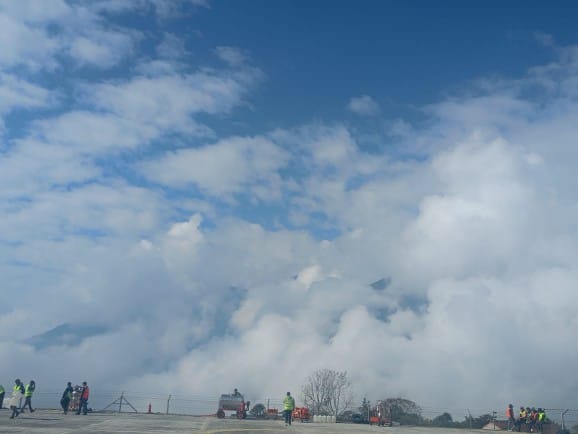
Clouds were rolling in again, slow and deliberate, as if mocking us. Sienna tried to reschedule her flight, fingers tapping nervously on her phone.
Bibek gathered us together. There was still one option left: walking down. It had been discussed that morning and dismissed too quickly, clinging to the hope of flight. Now, suddenly, it felt urgent. Helicopters came back onto the table. Bibek was on the phone constantly, calling, negotiating, pulling every string he had.
At 2 pm, a decision was made: we walk. NOW, and try for the jeeps.
The walk turned into a run almost immediately. News spreads fast in the mountains, and suddenly everyone was sprinting for the same limited number of jeeps. We ran down steep, muddy, sandy roads, duffel bags weighing over 25 kilos bouncing painfully on our backs. No porters this time. We passed donkeys, tiny villages, and crossed a river by jumping from loose rock to loose rock, breath ragged, legs screaming.
And then — nothing.
The path simply ended.
We joined a large group of stranded travelers standing in the middle of nowhere, surrounded by tall grass and steep drops. Just minutes earlier, we had watched a helicopter lift off, blades slicing through the air, even though we’d been told that was no longer an option. Chaos set in. Anxiety buzzed through the crowd. Voices grew louder. Everyone wanted out.
We were the last group to arrive, which meant, by mountain logic, the last to claim seats in the jeeps.
Stranded. Late afternoon. Nowhere. Himalayas.
After an hour and a half of running. After more than a week of trekking. Bodies broken, energy gone. We sat down in the grass, staring ahead, the realization slowly creeping in: we might have to hike the dangerous, treacherous trail back up. But this time it would be in the dark.
Bibek made the call. We continue on foot.
“Just one hour,” he grunted.
We moved again, grateful at least to be moving, even if doubt gnawed at us. The jeeps couldn’t reach the waiting crowd because of a landslide. Only a few vehicles trapped on our side were shuttling back and forth, picking up whoever they could - and paid up.
The road up was brutal. Steep. Rocky. Relentless.
Over 25 kilos on our backs. One step at a time. Kiki struggled to breathe, her breath loud and mechanical. My knee throbbed with every movement. Everyone was hurting, bodies openly rebelling.
I stayed behind Kiki, pushing her gently, step by step, her breathing sounding like Darth Vader echoing through the mountain air.
Then - hope.
After a sharp turn, we saw a jeep coming down toward us.
Bibek didn’t hesitate. He threw himself into the middle of the road, arms out, forcing the driver to stop.
In seconds, our duffels were flying into the open trunk.
Bibek spoke rapidly in Nepali, ushering us inside.
The driver protested. Bibek slipped money into his hand. A pause. A nod.
The driver turned the jeep around on a terrifyingly narrow mountain road.
Did we just hijack a car?!
From the jeep window, the distance to the landslide looked endless. What we thought was a two-hour hike easily looked like six. Impossible before dark.
As we bounced uphill, we nearly pushed a herd of donkeys and their herder toward the cliff edge. Nepali driving is nothing short of madness.
Eventually, the jeep screeched to a halt at a teahouse. The driver dumped our duffels onto the ground, said nothing, and disappeared back down the road.
We stood there, dusty, shaken, exhausted, but we had made great progress, and we were still together.