What goes up, must come down
We dropped nearly 1,000 meters in one day: 5180 meters down to 4200.
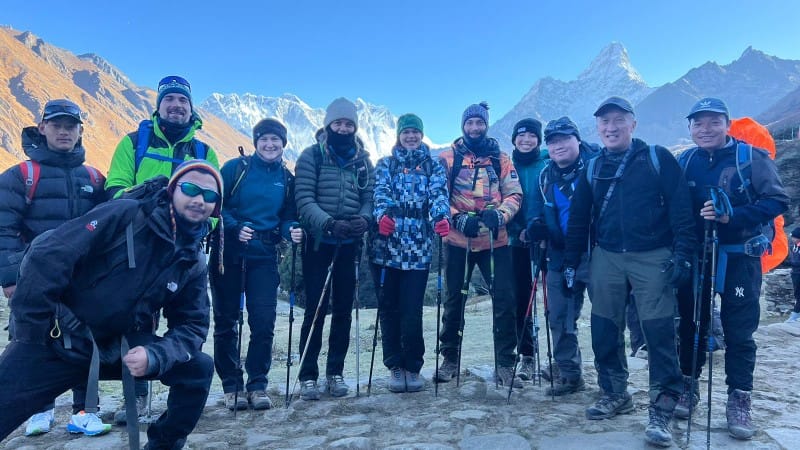
Some heroes in the group set off long before dawn—more night than morning—for an extra hike to a nearby peak. Three hours of climbing in the pitch-black cold, headlamps cutting through the frost. I gladly opted out and stayed wrapped in whatever warmth I could find. When they returned in time for breakfast, cheeks flushed from the altitude and the sunrise, I was genuinely impressed. Their energy felt almost superhuman.
That morning, Alfred, the senior member of our group, made a difficult but wise decision. He would fly back to Kathmandu by helicopter from Gorakshep. He had reached the goal he came for: Everest Base Camp. He had placed the bracelet his granddaughter gave him on the glacier, fulfilled his dream, and now his body was telling him it was time to take it easy. We hugged him goodbye amid the thin, cold air, already making dinner plans with him for when we’d reach Kathmandu a few days later. It was bittersweet; pride and farewell woven together.
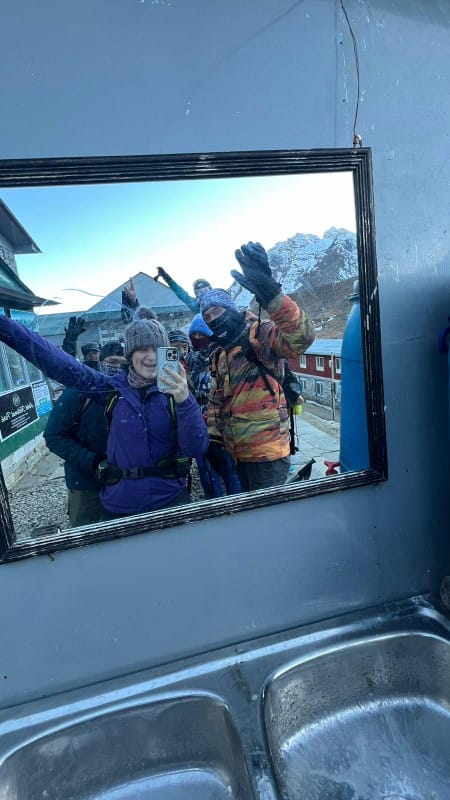
At 8 a.m., the rest of us stepped outside into the icy morning and began our descent. Each step down felt strangely heavier than the steps up had felt the days before. The altitude, the countless climbs, the sleepless nights, they were all taking their toll. Muscles ached in places I didn’t know I had. Breathing felt like hard work.
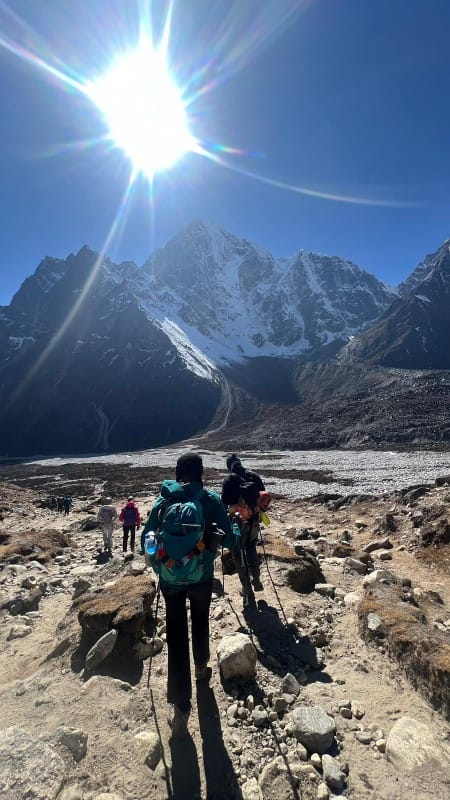
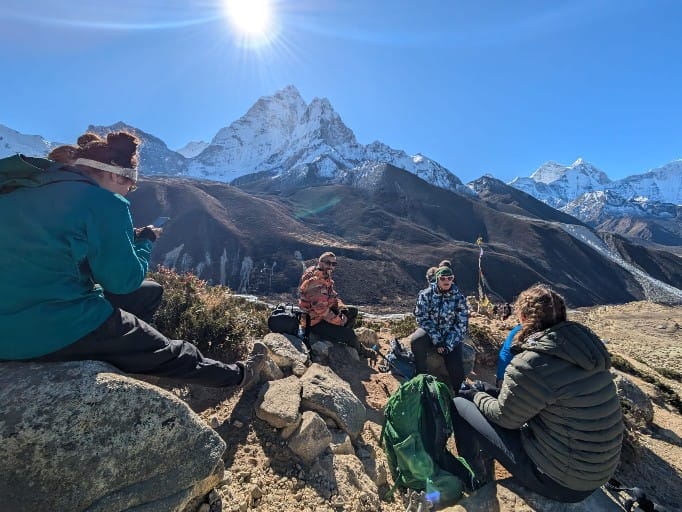
Yet the scenery shifted like a living, breathing storybook. In the morning, everything was still frozen: icy rocks, cold winds scraping over the glacier, a world of silence and stone. But with every hour, with every turn of the trail, life slowly returned. First, small patches of dust-stained moss. Then wisps of grass. Later, small bushes appeared like tiny acts of hope. The landscape softened with the descent; color returned.
We dropped nearly 1,000 meters in one day: 5180 meters down to 4200. Along the trail, yaks wandered lazily, blocking our path with the entitlement of creatures who know they own the mountains. Yak calves darted behind their mothers, surprisingly playful, and dogs trotted beside us as if guiding us along.
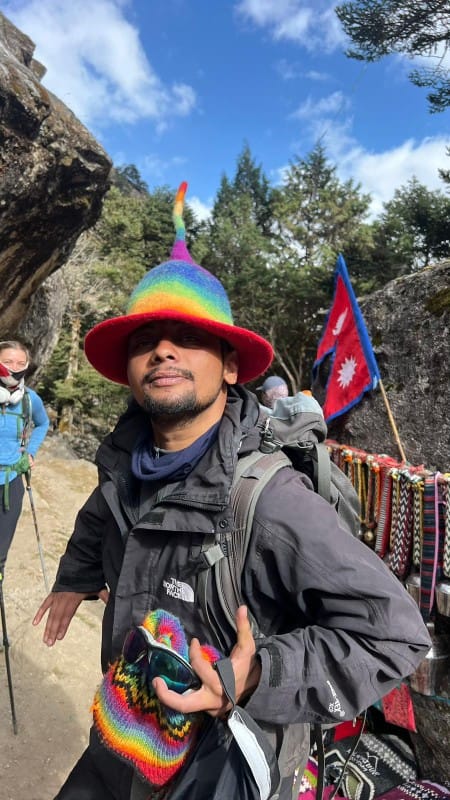
By late afternoon, we finally reached the teahouse. Exhausted but relieved, we collapsed into chairs, wrapped our hands around steaming cups of tea, and changed into warm, dry clothes. The common room felt like a sanctuary: dim, smoky, slightly chaotic. On the TV, an Australian show called Man vs. Wild was playing. A man dramatically drinking his own urine, intercut with sweeping panoramic drone shots. Maybe it was the exhaustion, perhaps the absurdity, but soon we were doubled over in laughter, unable to catch our breath - not from altitude this time, but from the ridiculousness of it all.
Before it got dark, we explored the tiny village: just a scattering of stone houses, narrow paths, and quiet grazing animals. We regrouped in a small bakery, savoring the warmth and the simple comfort of sitting down indoors.
As the sun disappeared behind the mountain peaks, the temperature plummeted. The cold bit straight through our layers. We hurried back to the teahouse, bracing against the icy wind.
Dinner was Dhal Bhat—finally something other than soup, now that altitude sickness was no longer looming over us. The familiar Nepali phrase “Dhal Bhat power, 24 hour” felt very real in that moment.
But the evening turned difficult. Kiki began shaking uncontrollably. Body trembling, tears running. Exhaustion, altitude, cold, and emotion were all catching up to her. It’s common on the descent, we were told, but it was still frightening to witness. She wore all her layers, all of mine too, and sat pressed as close as possible to the fire in the center of the room. Slowly, her breathing steadied; the shaking calmed; warmth returned.
Only once she felt stable again did we go to bed. Another early night, another cold room, another day survived.
Tomorrow, we’d cover the most distance of the entire trek.
And somehow, despite the pain and exhaustion, we were ready.